Overview
Sacral neuromodulation uses an implanted device to deliver mild electrical pulses near a sacral nerve involved in bladder and bowel signalling. It may be considered for urgency, urgency incontinence, non-obstructive urinary retention, or fecal incontinence after evaluation and discussion of other options.
Two-Stage Approach
Stage 1: Test Phase
A thin, flexible lead (wire) is placed near the sacral nerve under fluoroscopic guidance. The lead is connected to an external stimulator worn on the belt. During a trial period (typically 1-2 weeks), you can assess whether your symptoms improve.
Stage 2: Permanent Implant
If the diary shows a clinically meaningful improvement during the trial—often defined as at least 50% in key symptoms—a pulse generator is implanted under the skin in the upper buttock and connected to the lead. A successful trial does not guarantee that benefit will remain unchanged over time.
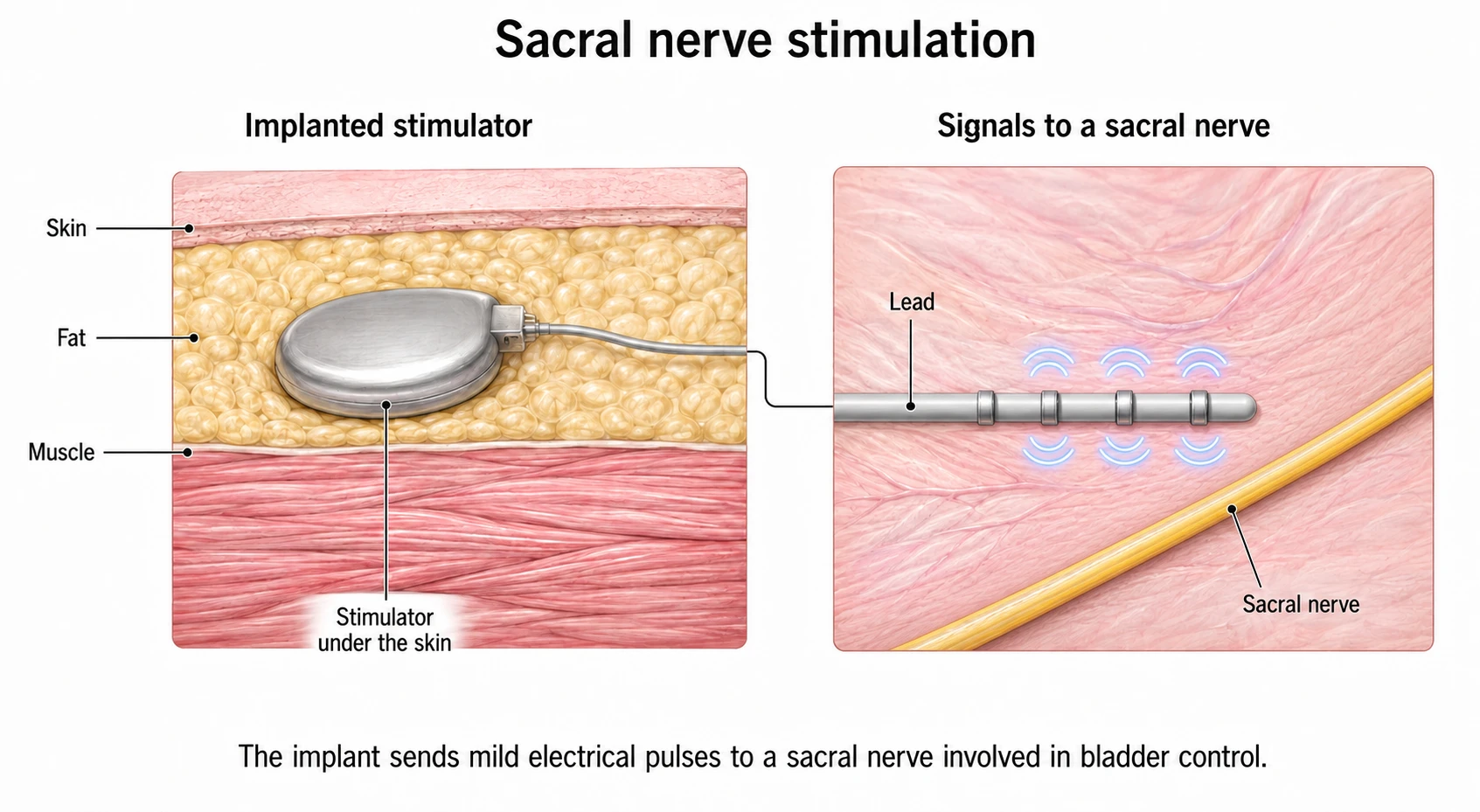
Conceptual illustration: an implant beneath the skin sends mild electrical pulses through a lead positioned near a sacral nerve.
Indications
- Overactive bladder unresponsive to conservative and medical treatments
- Urgency urinary incontinence
- Non-obstructive urinary retention
- Fecal incontinence unresponsive to other treatments
Expected Benefit and Device Care
- Only patients who benefit during the test phase usually proceed to permanent implantation
- The device can be adjusted over time with an external programmer
- Battery life and charging requirements depend on the model; generator replacement is a future procedure
- Symptoms may recur because of disease changes, lead movement, device problems, or loss of response
Considerations
- MRI access is device- and lead-specific and may depend on scan location and programming. Always tell imaging staff about the implant and carry the device identification card.
- The device requires periodic follow-up for adjustment and monitoring
- This is reserved for patients with severe, persistent symptoms who have not responded to other treatments
- Pregnancy safety data are limited; patients who are pregnant or planning pregnancy should discuss device management with the implanting team and obstetric clinician
Risks and Expectations
Sacral neuromodulation can provide meaningful improvement for patients who respond during testing, but it is not a guaranteed cure. Reprogramming, revision, battery replacement, or removal may be needed over the life of the device. Potential risks include:
- Pain — may radiate to the back, buttock, or thigh
- Skin irritation at the implant site
- Infection — at the device or lead site
- Lead migration — the electrode may shift from its original position
- Uncomfortable stimulation — stimulation settings may need adjustment
- Device malfunction — technical failures may require revision surgery
- Undesirable changes in bowel or voiding function
Sources
Clinical content updated July 2026. Source: AUA/SUFU Guideline on Idiopathic Overactive Bladder.