Overview
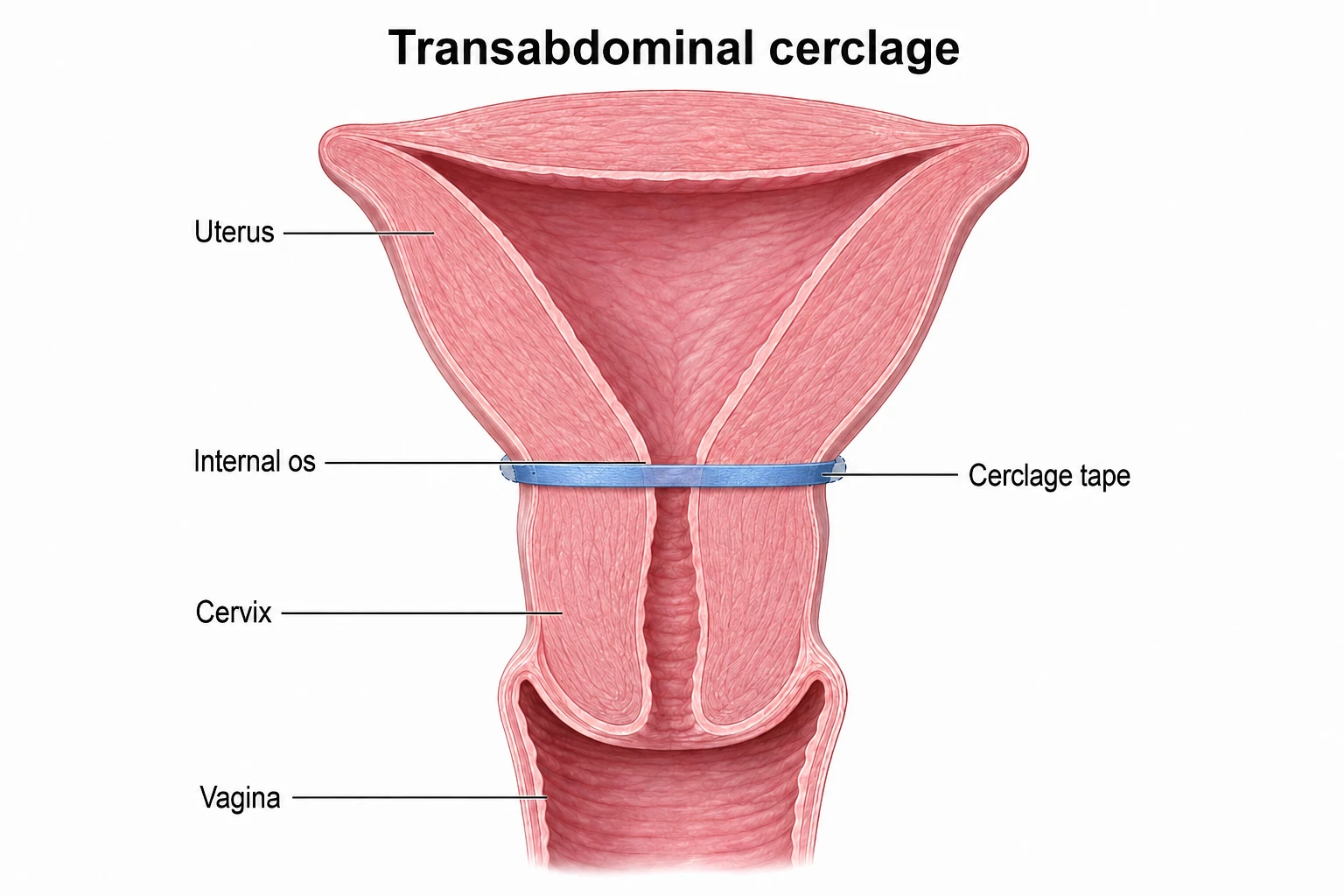
Simplified cutaway: the tape encircles the outside of the cervix at the internal os. Its front segment is drawn over the cutaway; adjacent vessels are omitted.
Laparoscopic cerclage is a minimally invasive procedure in which a suture or tape is placed around the cervix at the level of the internal os to provide structural support and prevent premature cervical dilation. It is typically performed in women with cervical insufficiency — a condition in which the cervix shortens and dilates prematurely, leading to recurrent second-trimester pregnancy loss or preterm delivery.
Because transabdominal cerclage requires abdominal surgery and future cesarean delivery, candidacy should be reviewed with a maternal-fetal medicine (MFM) specialist.
Indications
- Failed transvaginal cerclage: A previous history- or ultrasound-indicated vaginal cerclage followed by a spontaneous singleton delivery before 28 weeks is the principal evidence-based pathway
- Cervix unsuitable for a vaginal cerclage: For example, after trachelectomy or when there is too little accessible cervix for safe vaginal placement
- Selected complex cervical-insufficiency histories: Only after specialist review of prior pregnancies, records, anatomy, and alternatives
A prior LEEP/LLETZ or cone biopsy alone does not automatically mean that a transabdominal cerclage is needed. Many patients can instead be monitored or managed through a vaginal approach depending on history and cervical findings.
Timing
- Pre-pregnancy (interval) placement: Ideally performed before conception, which allows for optimal surgical visualization and suture positioning
- Early pregnancy placement: Can be performed in the first trimester (typically 10–14 weeks) when clinically indicated
- The cerclage is usually left in place for future pregnancies; delivery timing and management of pregnancy loss require an obstetric plan
Surgical Technique
- Performed under general anesthesia using laparoscopic instruments
- 3–4 small abdominal incisions (5–12 mm)
- A permanent suture or polyester tape is placed around the cervix at the cervicoisthmic junction, posterior to the uterine vessels
- Operative time is typically 45–90 minutes
- Usually performed as a day surgery procedure
What to Expect After Surgery
- Most patients go home the same day
- Mild pelvic discomfort for a few days, managed with simple analgesia
- Return to normal activities within 1–2 weeks
- Follow-up with an obstetrician and MFM team during subsequent pregnancies
- Planned cesarean delivery, generally between 37 and 39 weeks when no other indication changes timing
Advantages Over Transvaginal Cerclage
- Higher placement at the internal os level, providing more effective mechanical support
- Particularly beneficial when there is limited vaginal cervical length
- May improve pregnancy outcomes for appropriately selected high-risk patients
- Can often remain in place for future pregnancies
Risks and Expectations
Outcomes depend strongly on the reason for cerclage, prior pregnancy history, gestational age, and other causes of preterm birth. It reduces risk for selected patients but cannot guarantee a term birth. Potential risks include:
- Bleeding at the time of surgery
- Infection — uterine or wound infection
- Preterm premature rupture of membranes
- Preterm labour — despite the cerclage
- Injury to surrounding structures — uncommon
- Need for cesarean delivery — the cerclage is typically left in place permanently, and delivery is by planned cesarean section
Sources
Clinical content updated July 2026. Source: SMFM Consult Series #65: Transabdominal Cerclage.