Overview
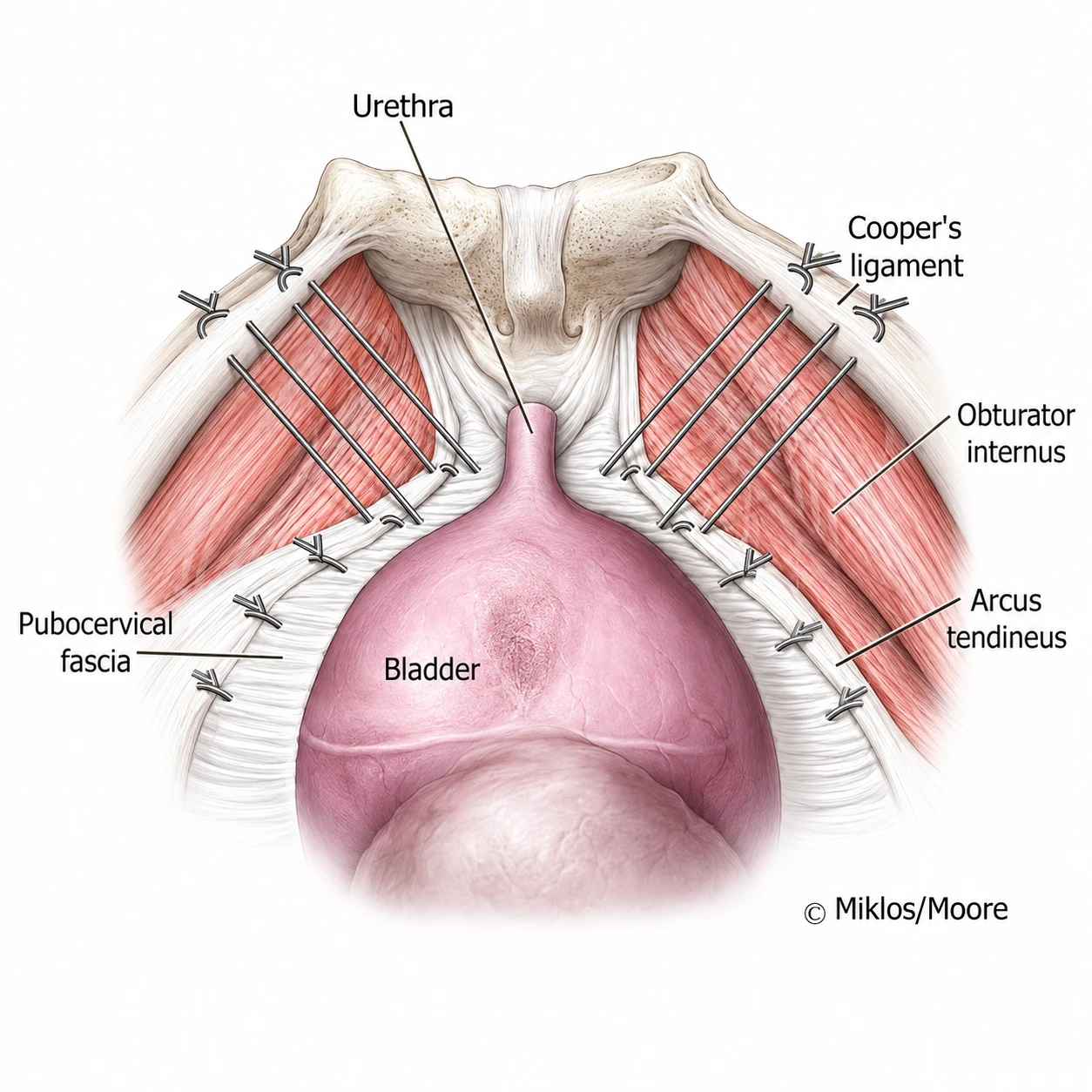
Laparoscopic Burch colposuspension is a well-established minimally invasive procedure for the treatment of stress urinary incontinence (SUI). The operation restores the normal anatomical support of the bladder neck and urethra by suspending the anterior vaginal wall to Cooper's ligament (the iliopectineal ligament) on the posterior aspect of the pubic bone. When combined with paravaginal repair, the procedure also corrects lateral detachment defects of the anterior vaginal wall that may contribute to anterior compartment prolapse (cystocele).
Indications
- Stress urinary incontinence: Involuntary leakage of urine with coughing, sneezing, laughing, or physical exertion
- Paravaginal defects: Lateral detachment of the endopelvic fascia contributing to anterior vaginal wall prolapse
- Recurrent SUI: Following failure of other anti-incontinence procedures
- Concomitant abdominal/laparoscopic surgery: When another pelvic procedure is being performed and SUI correction is also required
Surgical Technique
- Performed under general anesthesia using a laparoscopic approach
- 3–4 small abdominal incisions (5–12 mm)
- The space of Retzius (retropubic space) is developed to expose the anterior vaginal wall, bladder neck, and Cooper's ligament
- Burch component: Two to three permanent sutures are placed on each side of the urethra, securing the periurethral vaginal tissue to Cooper's ligament to elevate and support the bladder neck
- Paravaginal repair component: The detached lateral vaginal sulcus is reattached to the arcus tendineus fasciae pelvis (white line) and obturator fascia using interrupted sutures
- Operative time is typically 60–120 minutes
What to Expect After Surgery
- Hospital stay: typically 0–1 night
- Urinary catheter for 1–2 days postoperatively
- Mild pelvic and suprapubic discomfort, managed with simple analgesia
- Avoid heavy lifting and strenuous activity for 4–6 weeks
- Full recovery: approximately 4–6 weeks
- Most patients notice significant improvement in urinary leakage within the first few weeks
Outcomes
Burch colposuspension is an established non-mesh surgical option for stress urinary incontinence. When a true paravaginal defect also requires repair, both problems may be addressed during the same operation. Outcomes vary with patient factors, surgical technique, definition of success, and length of follow-up.
Risks and Expectations
Many patients have meaningful improvement, but stress incontinence can persist or recur. Potential risks include:
- Overactive bladder symptoms — new or worsened urgency or urgency incontinence can occur
- Voiding difficulty — usually temporary but may require intermittent self-catheterization or further treatment
- Pelvic organ prolapse — prolapse can develop or recur in another compartment over time
- Dyspareunia — pain during intercourse or reduced sensation may occur
- Stitch erosion into the bladder — rare, may require removal
- Bleeding requiring transfusion — rare
- Venous thromboembolism — rare
Sources
Clinical content updated July 2026. Source: AUA/SUFU Stress Urinary Incontinence Guideline.